
The lazy way to invest in real estate is to let a platform buy and run the property while you put in money and collect the payments. No tenants, no toilets, no mortgage application. The trade is that you give up control and some of the return to whoever does the work, and you usually cannot pull your money out on a whim.
So the questions that matter are simple. How little can you start with? How long is your money locked up? Do you own a fund, a specific house, or a loan? And what does the platform keep? The quick picks below sort the four platforms that answer those questions best, and each one is open to regular investors, not just the accredited crowd.
Best Passive Real Estate Investing Platforms
 FundriseBest overall, start with $10$10 minimum · quarterly liquidity2
 ArrivedPick the exact rental homes you ownshares from ~$103
 GroundfloorFixed-rate real estate notes, no fees$0 fees4
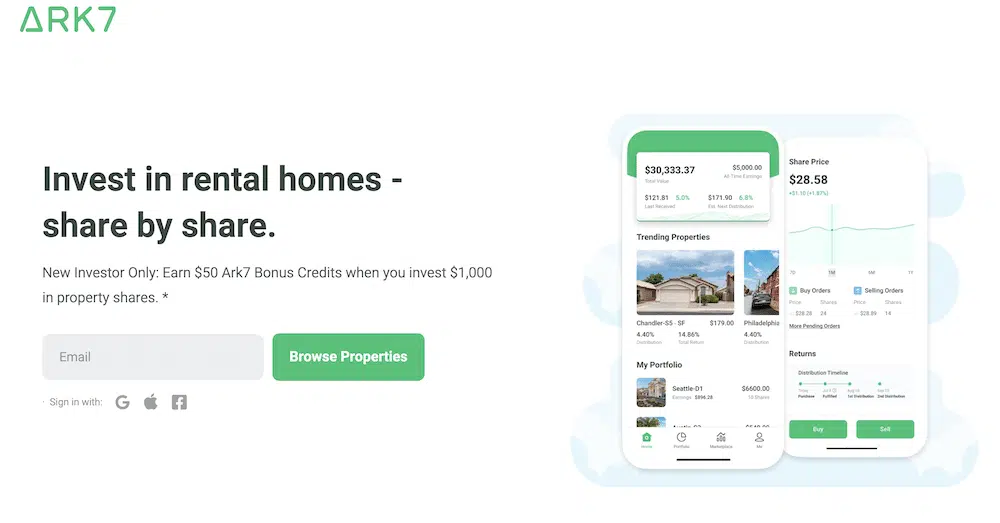 Ark7Rental home shares from $20$20 a share
Every platform here lets you start with $20 or less and pays you without you managing anything. Fundrise is the most hands-off, Arrived and Ark7 let you pick the actual houses, and Groundfloor pays a fixed rate on real estate loans instead of a share price. Here is how each one works and what it costs.
1. Fundrise
Best overall for hands-off investing from $10Best if you want one app that does everything.
Fundrise pools your money into diversified real estate funds and runs them for you. You pick a goal, it picks the properties. Ten dollars gets you in, and you can add a few dollars at a time.
Open an account and pick a plan: income, growth or balanced
Fund it with $10 or more, or set up auto-invest
Collect dividends and watch the fund value each quarter
Want the fine print? Fees, liquidity, and what you really own
$10 to start. Quarterly liquidity, so treat it as money you will not touch for years.
2. Arrived
Best for picking the actual houses you ownBest if you want to see the house you own.
Arrived sells shares in individual single-family rentals and vacation homes. You browse the listings, buy shares in the ones you like, and get paid when the tenant pays rent.
Browse the available homes and read each property page
Buy shares in the ones you like; recent trades priced $9 to $27 a share
Collect monthly dividends and sell on the secondary market if you need out early
Want the fine print? Fees, liquidity, and what you really own
Shares priced around $10. Monthly dividends, secondary market if you need to sell.
3. Groundfloor
Best for fixed returns with no feesBest if you want a fixed rate, not a share price.
Groundfloor lends to house flippers and lets you fund those loans. Instead of owning property, you own the debt, so you know the rate going in. The Signature Note pays 8.5% fixed over 12 months.
Open an account and deposit as little as $10
Pick individual loans from $10 or a Note from $100
Get paid monthly on Notes, or when each loan repays
Want the fine print? Fees, liquidity, and what you really own
$10 to start, $0 fees. Pick the 8.5% Signature Note for a monthly check.
4. Ark7
Best for $20 shares of rental homesBest if $20 is your budget this month.
Ark7 splits rental homes into shares that start at $20, then pays you a slice of the rent every month. It is the cheapest way on this page to own a piece of a specific house.
Sign up and browse the rental homes
Buy shares from $20 each in the ones you like
Get monthly distributions and sell after the minimum holding period
Want the fine print? Fees, liquidity, and what you really own
$20 a share. Monthly distributions, resale after the holding period.
How to Invest in Real Estate With Little Money
The old advice was to save a down payment, buy a duplex and live in half. That still works, but it takes years of saving and turns you into a landlord. The platforms above skip all of that by pooling small amounts from thousands of people and hiring professionals to run the property. You buy a slice, they do the work, you get paid your share of the rent or interest.
The smart move with little money is to start monthly rather than waiting for a lump sum. Ten dollars into Fundrise every payday builds a real position over a couple of years, and adding a Groundfloor note gives you a fixed monthly payment on top. Once you have a few hundred dollars working, pick a house or two on Arrived so part of your money is tied to something you can look at.
What to Look for in a Passive Real Estate Platform
Five things separate a good platform from a bad one. Check them before you fund an account.
- Minimum. Fundrise and Groundfloor start at $10 and Ark7 at $20 a share. Anything demanding $5,000 or more is built for a different reader.
- Liquidity. Fundrise runs quarterly redemption windows, Arrived and Ark7 have secondary markets after a holding period, and Groundfloor pays when the loan or note matures. None of them are a savings account.
- What you actually own. A fund (Fundrise), shares in one house (Arrived, Ark7) or a loan (Groundfloor). Funds diversify for you; single homes and loans do not.
- Fees. Groundfloor charges investors nothing on Notes and Loans. The others take a management cut, so read the percentage on the offering page, because it comes off the top every year.
- Who can invest. All four are open to non-accredited investors. Ark7 is US-only.
Passive Real Estate Investing FAQs
Open an account on a platform that runs the property for you and start with what you have. Fundrise takes $10 and spreads it across diversified funds, Groundfloor lets you fund real estate loans from $10 with no fees, and Ark7 sells shares of specific rental homes from $20. None of them require you to be an accredited investor.
Yes. Fundrise opens an account with $10 and Groundfloor funds individual loans from $10. You will not get rich on ten dollars, but you will own real estate exposure that pays dividends or interest, and you can add to it every month.
A managed fund. Fundrise picks the properties, manages them and pays you dividends; your only job is choosing a plan and funding it. Arrived is nearly as passive but you choose the homes yourself, and its team handles tenants, maintenance and renewals.
Slowly, on every platform here. Fundrise offers quarterly liquidity, Arrived and Ark7 let you sell shares to other investors after a holding period, and Groundfloor pays out when a loan repays or a 12-month note matures. Only invest money you will not need for a few years.
It is real estate, so values can fall and platforms can pause redemptions in a bad market. The platforms on this page are open to non-accredited investors and publish their track records, including losing properties on Arrived. Spread your money across a few, start small, and read the fee and liquidity terms before you fund.
Which Platform Should You Start With?
| Platform | Best for | Minimum | Liquidity |
|---|---|---|---|
| Fundrise | Hands-off diversified funds | $10 | Quarterly |
| Arrived | Choosing the homes you own | ~$10 a share | Secondary market |
| Groundfloor | Fixed 8.5% note, no fees | $10 | 12-month note |
| Ark7 | $20 rental home shares | $20 a share | After hold period |
If you want one answer, it is Fundrise: $10 in, diversified from day one, and nothing to manage. If you want to see the house, Arrived. If you want a fixed rate and no fees, Groundfloor. If $20 is the budget, Ark7. There is no rule that says you have to pick only one.
Whichever you choose, treat it as money you will not touch for a few years. The lazy way to invest in real estate works because time does the compounding, not because any of these platforms will make you rich by next spring.
Oh — and if you want to actually get paid while you're at it, there are dozens of new apps and offers right now where top earners made $300+ last week. Check them out here.
